


Portugal remains a high-demand destination for study, work, retirement and remote work, but visa refusal rates show that a significant number of applications still fail on avoidable grounds. Understanding how Portuguese consulates, VFS centers and the immigration agency AIMA assess applications is essential for anyone evaluating a move. This briefing summarizes the main reasons Portugal short- and long-stay visas are rejected, and outlines concrete measures to reduce the risk of refusal.
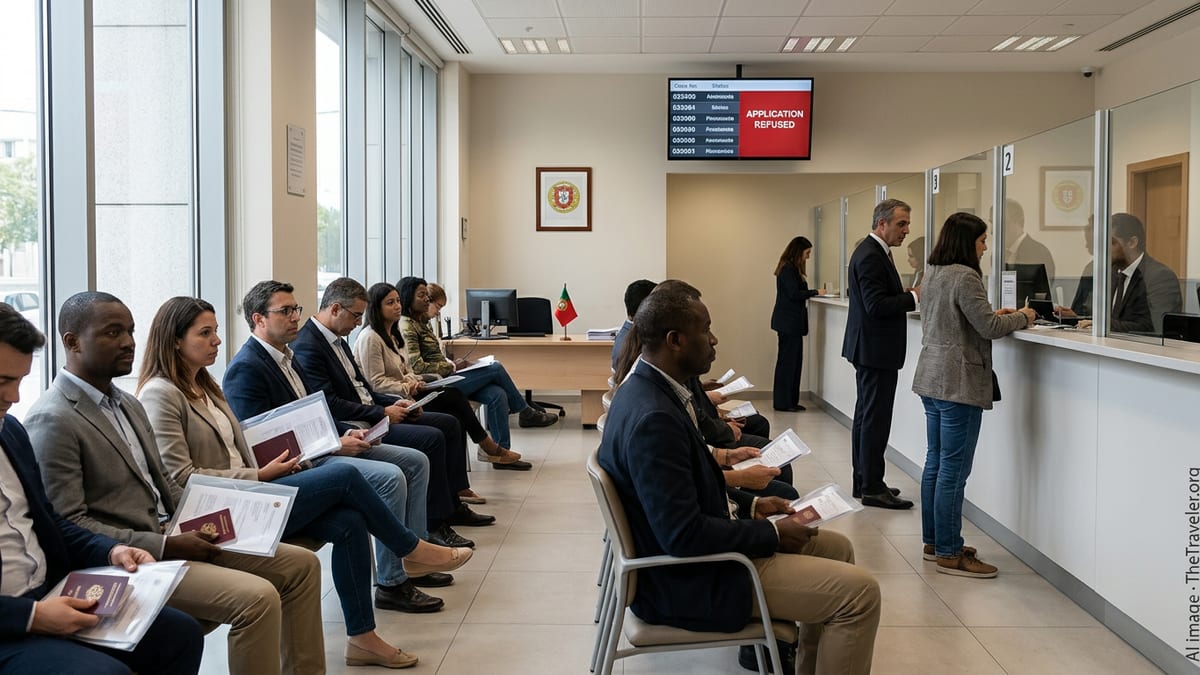
Portugal Visa Refusal Landscape
Portugal processes both short-stay Schengen visas and long-stay national visas for residence. According to recent assessments based on European Commission statistics, Portugal’s Schengen visa refusal rate in the most recent published year was around the low double digits worldwide, with lower rates for some source countries and higher for others. This is broadly in line with overall Schengen trends, but the distribution of refusals is highly concentrated in specific, recurring errors rather than random outcomes.
For long-stay residency visas such as D-type categories (retiree or passive income visas, digital nomad visas, study visas and family reunification), there is no consolidated public rejection rate. However, law firms and relocation advisors report that a significant minority of applications are refused at the consular stage, often on technical or documentary grounds rather than for outright ineligibility. Applicants should therefore treat compliance with formal requirements as a core risk factor, not an administrative detail.
Responsibility for decision-making is split between Portuguese consulates abroad, the Ministry of Foreign Affairs, and the national immigration agency AIMA, which in late 2023 replaced the former SEF. While AIMA mainly handles post-arrival residence permits, its scrutiny of security, documentation integrity and financial sufficiency informs both visa and residence outcomes. Any perceived inconsistency between the consular file and AIMA’s records can trigger refusals or requests for additional evidence at a later stage.
Across both short- and long-stay visas, the most commonly cited refusal reasons fall into a few clusters: incomplete or incorrect documentation, weak justification of the purpose and conditions of stay, insufficient or unclear financial means, doubts about accommodation, security and public policy flags, and credibility issues arising during interviews or cross-checks.
Documentation Errors and Formal Non-Compliance
Incomplete or non-compliant documentation is consistently identified by consulates and visa intermediaries as one of the leading causes of Portugal visa refusals. Recent guidance from relocation and visa advisory firms indicates that missing forms, unsigned declarations and expired documents are among the simplest yet most frequent triggers for rejection decisions for both Schengen and national visas.([portugalresidencyadvisors.com](https://www.portugalresidencyadvisors.com/10-reasons-why-visa-application-gets-rejected/?utm_source=openai))
Typical documentation-related refusal grounds include: passports that will expire too soon after the intended stay, passports with insufficient blank pages, missing or outdated criminal record certificates, untranslatable documents submitted without certified translations, and civil status or marriage documents that lack required apostilles or legalization. Some consulates report that incorrectly formatted photographs and non-compliant travel insurance policies still account for a noticeable share of refusals in short-stay applications.([simpletravelpath.com](https://simpletravelpath.com/portugal-visa-rejection/?utm_source=openai))
From a relocation planning perspective, the key risk is that Portugal generally does not invite applicants to correct these issues after submission. Consular authorities are entitled to decide based on the file as received and to refuse the visa if any required element is absent by the time of decision. This means that even applicants who substantively meet financial and legal conditions can be refused solely due to formal oversights.
To mitigate this risk, applicants should align their document set meticulously with the checklist of the specific consulate where they apply, verify validity periods for all certificates and passports, and ensure that translations, apostilles and notarizations comply with local Portuguese requirements rather than only home-country standards. Using recent originals rather than older copies and double-checking that every item on the checklist is present in the file are basic, but effective, safeguards.
Insufficient or Unclear Financial Means
Proof of sufficient and reliable financial means is central to Portugal’s visa adjudication, particularly for long-stay categories. Advisory sources focused on Portuguese residence visas report that insufficient income or savings, or unclear origin of funds, is one of the most frequent grounds for refusal for passive income visas and digital nomad visas.([knowledge.movingto.com](https://knowledge.movingto.com/en-US/kb/article/28/what-are-the-main-reasons-for-d7-visa-application-rejections?utm_source=openai))
For Schengen short-stay visas, consulates typically apply a minimum daily subsistence threshold, adjusted by reference to national guidelines and local cost of living. Applicants must show that they can cover travel, accommodation and living expenses for the entire period in the Schengen Area. Visa assistance providers note that rejections are common where bank statements show low or unstable balances, sudden unexplained deposits, or reliance on third parties without clear sponsorship documentation.([simpletravelpath.com](https://simpletravelpath.com/portugal-visa-rejection/?utm_source=openai))
For long-stay residence visas, specific income floors are usually benchmarked against the Portuguese minimum wage or similar reference amounts. Recent practice notes for the D7 passive income visa, for example, highlight that applications are regularly refused when applicants present income close to the theoretical minimum but do not demonstrate a realistic budget for housing, utilities, healthcare and other living costs. Study visa guidance from a Portuguese embassy similarly attributes a substantial share of rejections to inadequate or poorly evidenced financial support, particularly for the first year of studies.([knowledge.movingto.com](https://knowledge.movingto.com/en-US/kb/article/28/what-are-the-main-reasons-for-d7-visa-application-rejections?utm_source=openai))
To reduce financial-related refusal risk, applicants should: present several months of consistent bank statements rather than isolated balances; add explanatory notes for large transfers; provide formal sponsorship letters with supporting documents if relying on a sponsor; and, for residence visas, show an income margin above the bare minimum to demonstrate resilience against cost fluctuations. Where funds come from business activities, investments or pensions, evidence of regularity, legality and sustainability is more persuasive than a single large deposit.
Weak Justification of Purpose and Conditions of Stay
Portuguese law requires that applicants clearly justify the objective and conditions of their intended stay. For residence visas, consular refusal notices frequently reference a generic ground indicating that the “purpose and conditions of stay” were not adequately demonstrated. Relocation specialists focusing on Portugal report this as a major reason for refusal of digital nomad (D8) and similar remote work residence visas, where applicants provided vague project descriptions or incomplete contracts.([anchorless.io](https://anchorless.io/blog/moving/portuguese-residency-visa-refusal/?utm_source=openai))
Common manifestations include incomplete or inconsistent travel itineraries for Schengen visas, non-specific motivation letters that do not align with supporting documentation, and gaps between stated plans and real capacity. For instance, an applicant may claim to be moving to Portugal to work remotely yet fail to submit binding contracts or employer letters confirming remote work approval. For study visas, insufficient evidence of genuine enrollment or unclear academic plans often leads to doubts regarding the real purpose of the stay.([embportugalnicosia.org](https://www.embportugalnicosia.org/visa-information/student/?utm_source=openai))
The credibility of the stated purpose is also tested during in-person interviews. Inconsistent answers about accommodation, employment, study plans, or family situation can cause consular officers to doubt the genuine intent of the stay, resulting in refusals even when documents appear complete. Advisors note that consulates are particularly cautious where they suspect that a nominal purpose, such as short-term tourism, masks an intention to overstay or work without authorization.([portugalresidencyadvisors.com](https://www.portugalresidencyadvisors.com/10-reasons-why-visa-application-gets-rejected/?utm_source=openai))
Applicants can mitigate this by preparing a coherent narrative that connects all elements of the file: travel or relocation timeline, work or study plans, accommodation arrangements and financial means. Detailed personal statements or cover letters, admissions letters, employment agreements, and structured itineraries contribute to a more convincing explanation of the stay, especially for long-term relocation categories.
Accommodation, Travel Insurance and Other Technical Gaps
Several technical requirements function as gatekeepers for Portugal visa approval. Among them, proof of accommodation and compliant travel medical insurance are particularly important for short-stay visas, while stable housing arrangements play a growing role for residence visas. Visa facilitation platforms list unclear or unverifiable accommodation as a recurrent cause of refusal, for example where bookings are provisional, unconfirmed, or inconsistent with the travel dates listed on the application.([simpletravelpath.com](https://simpletravelpath.com/portugal-visa-rejection/?utm_source=openai))
For Schengen visas, applicants must usually present hotel reservations, rental contracts or formal invitation letters that cover the full period of stay. If documents suggest that the applicant might be left without accommodation for part of the visit, or if the host’s capacity is questionable, consulates may opt to refuse the visa. For residence visas, recent practitioner reports describe increased scrutiny of long-term leases and property contracts, with authorities rejecting applications that rely on informal or unverifiable housing arrangements.
Travel medical insurance is another strictly enforced requirement for Schengen visas. European regulations require minimum coverage of 30,000 euros for medical emergencies, repatriation and related costs for the entire Schengen area and full duration of stay. Insurers and visa guidance materials indicate that non-compliant policies, destinations limited only to Portugal rather than Schengen, or coverage gaps for certain dates frequently trigger refusals, even when all other aspects of the application are strong.([yuha.be](https://yuha.be/admin/kcfinder/upload/files/74917526356.pdf?utm_source=openai))
To minimize these technical risks, applicants should obtain confirmable accommodation that clearly matches the travel period, avoid tentative bookings that may be canceled automatically, and ensure that any host invitation letters are accompanied by proof of residence and identity from the host. For insurance, applicants should use policies explicitly designed for Schengen visa purposes, with clear coverage amounts, territories and dates printed on the certificate.
Security, Public Policy and Integrity Concerns
Although less frequent than documentation or financial issues, security and integrity concerns are taken very seriously by Portuguese authorities and lead to immediate refusals when present. Legal provisions allow consulates and AIMA to deny visas where there are indications of threats to public policy, internal security, public health or international relations. Recent guidance on Portuguese residence visa refusals notes that these clauses are used in connection with criminal records, prior immigration violations and suspected document fraud.([anchorless.io](https://anchorless.io/blog/moving/portuguese-residency-visa-refusal/?utm_source=openai))
Common situations include undisclosed prior visa refusals or overstays in Portugal or other Schengen states, criminal convictions that fall within security thresholds, and the use of forged or altered travel documents, bank statements or civil status certificates. Once such concerns are identified, they can have lasting consequences beyond the immediate refusal, potentially affecting future application credibility.
For investment-led programs such as the former Portuguese golden visa, anti money laundering controls and verification of the legality and origin of funds are central. Legal and financial advisory sources highlight cases where applications were refused because applicants failed to document the provenance of funds, mixed personal and corporate assets without clear separation, or used high-risk financial channels. Similar scrutiny is extending to other visa categories that rely heavily on investment or business income.([portugalresidency.pro](https://portugalresidency.pro/what-happens-if-your-portuguese-golden-visa-application-is-denied/?utm_source=openai))
To avoid integrity-related refusals, applicants should disclose prior immigration history honestly, obtain updated police clearance certificates from all relevant jurisdictions, and ensure that all financial and civil documents are authentic, traceable and, where necessary, verifiable by third parties. Using regulated financial institutions, keeping clear audit trails for major transactions and cooperating fully with additional information requests can help reassure authorities about compliance.
Responding to Rejections and Reducing Future Risk
Applicants who receive a Portugal visa refusal typically receive a standardized form indicating specific legal grounds, sometimes with brief narrative explanation. For Schengen visas, this takes the form of a refusal letter listing codes corresponding to reasons such as inadequate documentation, insufficient means or doubts about the purpose of stay. For national residence visas, consulates and AIMA issue written decisions that may be more detailed but still rely on categorized grounds like insufficient justification of the stay or lack of financial proof.([visard.io](https://www.visard.io/blog/common-portugal-visa-rejection-reasons-and-how-to-avoid-them-in-2026?utm_source=openai))
In many cases, the most practical strategy is to correct the deficiencies and submit a new application, especially where the refusal is clearly linked to missing documents, expired certificates or weak financial evidence. Improvements should be substantial rather than cosmetic: for instance, increasing account balances, providing more months of statements, clarifying accommodation and updating personal statements. Where security, integrity or serious credibility issues are cited, professional legal advice is strongly advisable before reapplying.
Appeal mechanisms exist under both Schengen and national Portuguese law, but they can be time consuming and may not be suitable for all applicants. Appeals generally require detailed written submissions in Portuguese or through local legal representation, systematically addressing each refusal ground and providing new or clarified evidence. Given this complexity, many prospective movers instead focus on strengthening a new application rather than challenging a prior decision, unless there is a strong argument that the refusal was manifestly incorrect.
Proactively, the most effective way to avoid future refusals is to approach the application as a structured project: start document collection early to allow for apostilles and translations; model a realistic budget based on local living costs; write a coherent relocation plan; and cross-check every element against the specific consulate’s instructions immediately before submission, as procedural nuances and checklists are periodically updated.
The Takeaway
Portugal’s visa regime is accessible for many categories of applicants, yet refusal data and practitioner experience show that a meaningful proportion of applications fail on avoidable grounds. The most prevalent rejection reasons are concentrated around incomplete documentation, insufficient or unclear financial means, weak or inconsistent justification of the purpose and conditions of stay, technical gaps in accommodation and insurance evidence, and, less frequently, security and integrity concerns.
For individuals evaluating a move to Portugal, this implies that visa feasibility often depends less on the abstract eligibility criteria and more on the quality, coherence and completeness of the application file. A cautious, evidence-driven approach that anticipates consular scrutiny and ties together purpose, finances and accommodation can substantially reduce the likelihood of refusal and associated delays or additional costs.
While no application can be guaranteed approval, treating the visa process as a central component of relocation planning rather than an administrative afterthought is one of the most effective ways to convert a theoretical right to move into a practical, successful relocation outcome.
FAQ
Q1. What is the most common reason Portugal visas are rejected?
Incomplete or non-compliant documentation and insufficiently evidenced financial means are consistently cited as the leading grounds for Portugal visa refusals, particularly when required forms, bank statements or certificates are missing, expired or unclear.
Q2. Do Portugal consulates usually ask for missing documents before refusing a visa?
Consulates may request additional information, but they are not obliged to do so. Many refusals are issued without prior requests when key documents are absent, so applicants should assume that the first submission must be complete.
Q3. How important is financial proof for long-stay residence visas like D7 or digital nomad visas?
Financial proof is critical. Authorities assess not only whether income meets the formal minimums but also whether it appears stable, lawful and sufficient to cover realistic living costs in Portugal over time.
Q4. Can weak accommodation evidence cause a Portugal visa refusal?
Yes. Unclear, partial or unverifiable accommodation arrangements are a frequent refusal ground for short-stay visas and an increasing concern for residence visas that rely on informal or temporary housing solutions.
Q5. How do prior overstays in Schengen affect a Portugal visa application?
Previous overstays or immigration violations in Portugal or other Schengen states can lead to refusals on public policy or security grounds and may damage credibility, even if the applicant otherwise meets current requirements.
Q6. Are Portugal study visa applications often refused for non-academic reasons?
Yes. Many study visa refusals are linked to inadequate financial evidence, unclear accommodation or doubts about the genuine intention to study, rather than the academic offer itself.
Q7. Is it better to appeal a refusal or reapply with stronger documentation?
This depends on the case. For straightforward documentation or financial issues, reapplying with significantly improved evidence is often more practical. For refusals based on legal interpretation or security grounds, professional advice and formal appeal may be warranted.
Q8. Does travel medical insurance really affect the decision for Schengen visas?
Yes. Non-compliant insurance, such as insufficient coverage, incorrect territorial scope or gaps in validity dates, is a common and strictly enforced reason for Portugal Schengen visa refusals.
Q9. How can applicants strengthen the “purpose of stay” in a Portugal visa file?
Applicants should provide detailed and consistent documentation that supports their stated purpose, such as employment contracts, enrollment letters, relocation plans, project descriptions and itineraries that align with their financial and accommodation evidence.
Q10. Are Portugal visa rejection rates increasing?
Recent Schengen statistics indicate that Portugal’s overall refusal rate remains comparable to many other Schengen states, though demand spikes and tighter scrutiny in certain categories have led to noticeable rejections, especially where applications are rushed or poorly documented.