


More news on this day
Unions representing staff at Paris Charles de Gaulle and Paris Orly have filed a four-day strike notice covering 17–20 December 2026, the first weekend of France’s Christmas school holidays, raising the prospect of disruption for travellers but with the extent of any impact on flights still uncertain.
Get the latest news straight to your inbox!
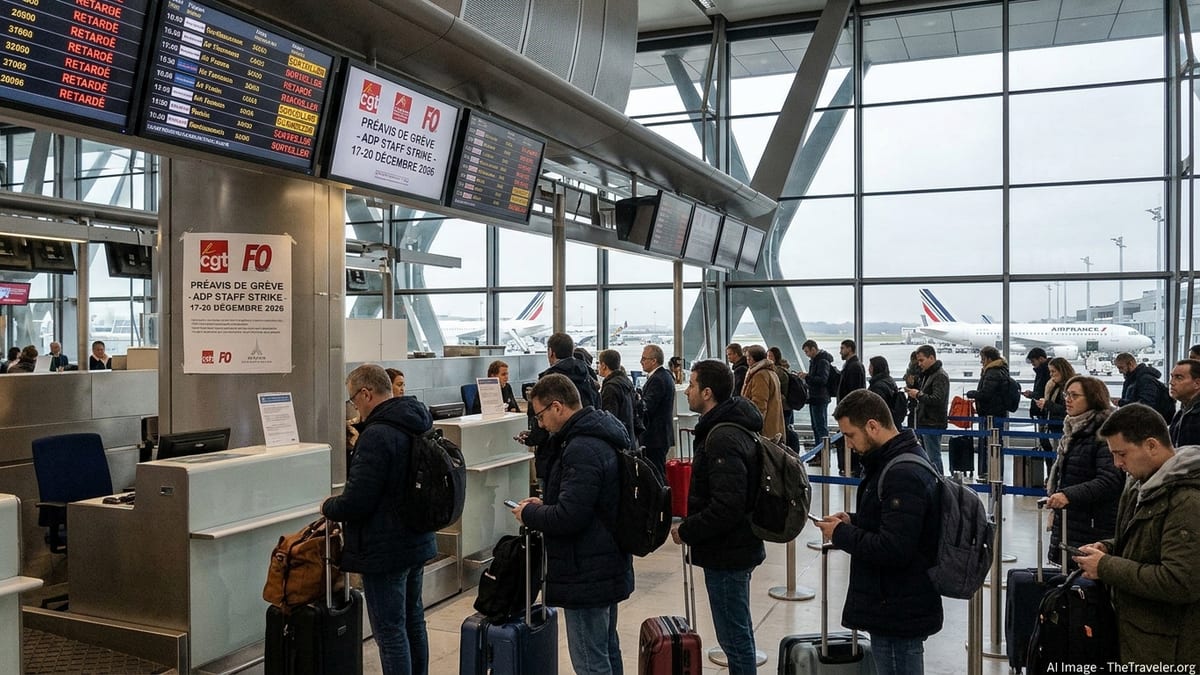
What has been announced at Paris’s two main airports?
Two unions at Aéroports de Paris (ADP), CGT and Force Ouvrière (FO), have formally lodged strike notices covering employees of the ADP group at both Paris-Charles de Gaulle and Paris-Orly airports. The notices run from 05:00 on Thursday 17 December 2026 until 24:00 on Sunday 20 December 2026, which coincides with the first weekend of the French Christmas school holidays.
The call to strike targets staff employed by ADP, the company that operates the two Paris airports and manages activities such as airport infrastructure, certain ground services and security processes. At this stage, the notices amount to an authorisation for staff to take part in industrial action during the stated period rather than a guarantee that large numbers will do so. Participation levels, which will depend on how many employees decide to stop work and for how long, remain unknown.
Because the notices apply ahead of one of the busiest travel weekends of the year in France, airlines and passengers are assessing the potential for queues, delays or schedule changes at both airports. However, no binding flight cancellation orders or air traffic restrictions have yet been issued by the French civil aviation authority for the December 17–20 period, and ADP has not published any operational adjustment plans linked directly to these strike notices.
Union demands and context of the dispute
The strike notices follow a breakdown in negotiations between CGT and FO and the ADP management on a package of measures related to pay and working conditions. The unions are calling for a 20 percent increase in the home-to-work transport allowance paid to employees, arguing that commuting costs have risen sharply. They are also demanding the payment of a one-off fuel bonus of 1,000 euros per employee to offset higher fuel prices affecting workers who drive to the airports.
In addition to financial demands, union representatives are seeking commitments on staffing levels and job protection. They have requested that vacant posts be filled across all departments at ADP, indicating concerns about workloads and service quality. They also want the creation of a joint appeals committee to review cases where employees temporarily or permanently lose their airport security badges, a sanction that can make it impossible for staff to continue in their roles in secure airside areas.
The unions say that their decision to call the pre-Christmas strike is partly driven by broader social tensions around purchasing power in France in 2026, and they point to recent industrial action days on 5 and 17 November that involved a wide range of public and private sector workers. According to union statements reported in the French press, CGT and FO accuse ADP of refusing to reach what they consider to be a fair agreement, highlighting that the company has recently earmarked increased sums for shareholders while, in their view, offering insufficient measures to support employees facing inflation and higher transport costs.
Potential impact on flights and airport operations
For now, the filing of strike notices does not automatically translate into specific, confirmed disruption at Paris Charles de Gaulle or Orly. The scale of any impact will depend on several factors, starting with the number and roles of ADP employees who choose to participate. ADP’s workforce covers a range of functions, including passenger services, airport security checkpoints, maintenance and certain ground operations. Work stoppages by staff in these areas can affect how quickly passengers and baggage move through the airports, even when airlines and air traffic control services are operating normally.
As of 29 November 2026, the French civil aviation authority, the Direction générale de l’Aviation civile (DGAC), has not issued advance orders for airlines to reduce their flight schedules for 17–20 December in connection with this particular movement. Nor has it published guidance advising passengers to avoid travel on those dates. That stands in contrast to some earlier air traffic control strikes in France where the DGAC required airlines to cut a defined percentage of flights in advance on safety and capacity grounds. At this point, the December ADP staff strike remains a company-level dispute without direct air traffic control involvement.
Even without DGAC-mandated cancellations, passengers could still face longer waiting times at check-in, security or baggage reclaim if staffing is reduced, especially during peak morning and evening waves. Ground handling at Paris airports is shared between ADP subsidiaries and independent handlers working for specific airlines, so not all functions are directly affected by the ADP strike notice. Low-cost carriers and some long-haul airlines use separate handling companies, which may limit operational disruption if those firms’ staff are not involved in the action. However, queues at centralised airport security checkpoints or passport control, where ADP-managed infrastructure and staff are key, could create bottlenecks that affect all departing passengers regardless of airline.
How this fits into recent labour tensions at ADP and in France
The December 17–20 strike call at Paris airports does not come in isolation. It follows two national days of industrial action earlier in November that brought together unions representing public servants, transport workers and employees in other sectors around pay and cost-of-living demands. Although those nationwide protests caused some delays to public transport services, they did not lead to widespread flight cancellations at Paris airports, and impacts were generally manageable for air travellers.
Within ADP, the unions’ pay and staffing demands are emerging against the backdrop of a major investment and expansion programme for the Paris airport system during the 2027–2034 period. In recent months, the French state and Groupe ADP have agreed on an economic regulation contract that will underpin more than 8 billion euros of planned investment in Paris-Charles de Gaulle, Orly and Le Bourget airports. The unions have highlighted the scale of this investment, and what they describe as generous shareholder returns, in arguing that the operator should also commit more resources to wages, allowances and job security for staff who ensure daily operations.
This latest dispute also echoes past episodes of tension at ADP around annual wage negotiations and bonuses. Recent company reports show that in previous years, when wage talks did not lead to collective agreements, management sometimes implemented unilateral pay increases or one-off value-sharing bonuses for staff. Union organisations now argue that general increases have not kept up with the spike in living costs seen in 2026 and that peripheral measures such as fuel bonuses and upgraded transport allowances are necessary to protect purchasing power, especially for lower-paid workers who must commute at unsociable hours to remote airport sites.
Practical advice for travellers booked through CDG or Orly
Travellers scheduled to fly into or out of Paris Charles de Gaulle or Paris Orly between Thursday 17 December and Sunday 20 December 2026 should monitor their flights closely in the weeks and days leading up to departure. Because the strike notices apply to ADP staff rather than directly to airline employees, airlines may not yet be in a position to adjust schedules or rebook passengers. Once it becomes clearer how many workers intend to participate, airlines could communicate specific changes such as revised departure times or consolidated services, particularly on busy routes where they have some flexibility in aircraft and crew deployment.
As of the end of November, neither ADP nor the DGAC has issued detailed guidance for passengers regarding the December strike period. There are no formal instructions yet to arrive at the airport earlier than usual, but given that the dates coincide with the start of the Christmas school holidays in France, passengers may wish to allow more time than usual for check-in, security and border controls. Travellers connecting through Paris from non-Schengen to Schengen flights, or vice versa, should pay particular attention to minimum connection times specified on their tickets and consider options to rebook onto longer connections if their itinerary is especially tight.
In the coming days, further negotiations between ADP management and the unions could lead to changes in the situation. The unions have indicated that they are prepared to resume talks and have effectively given ADP management a window of several weeks to come back to the table before the start of the school holidays. That leaves open multiple scenarios, ranging from a negotiated agreement that leads to the withdrawal or scaling back of the strike call, through to targeted work stoppages in selected departments, or a more extensive mobilisation if discussions break down entirely. Until there is clarity, travellers planning to pass through Paris should keep checking airline notifications, monitor ADP’s airport information channels and be prepared for the possibility of longer processing times at peak periods over the 17–20 December weekend.