


More news on this day
A catastrophic fire beside Glasgow Central Station has shuttered Scotland’s busiest rail hub and unleashed travel turmoil across the network, exposing how a single urban blaze can ripple through Scotland, England, and cross-border routes in a stark test of the UK’s transport resilience.
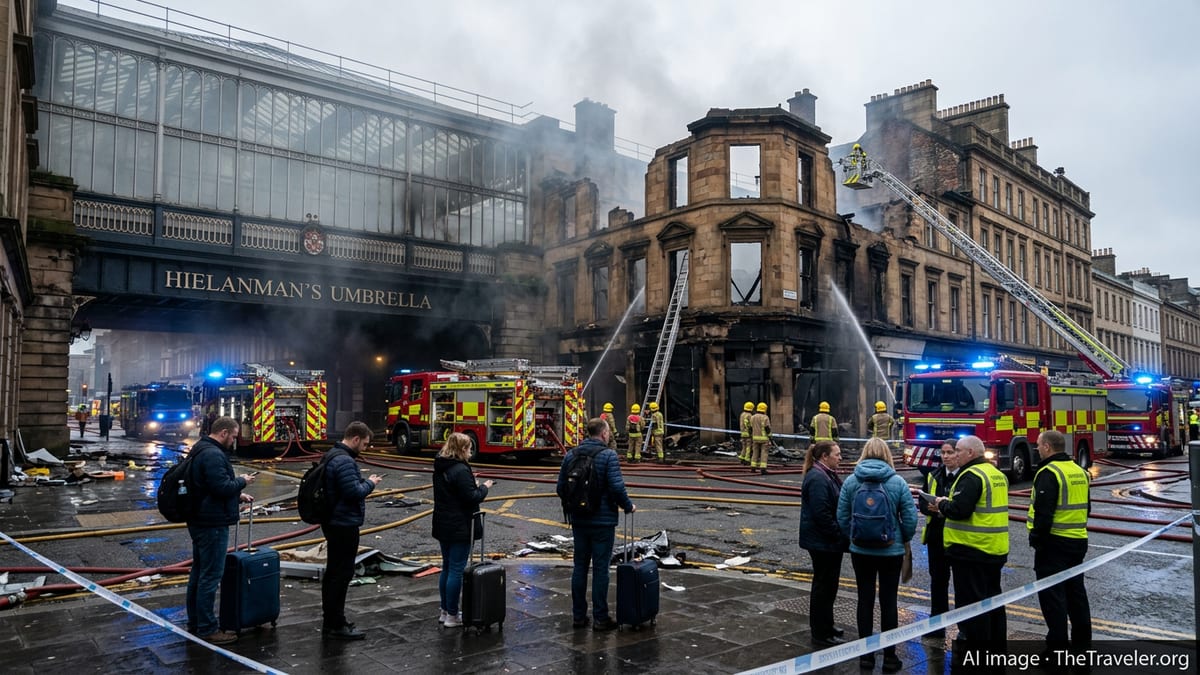
Fire Rips Through Union Street as Station Falls Silent
The alarm was raised on Sunday 8 March after flames engulfed the ground floor of a four-storey commercial block on Union Street, metres from Glasgow Central’s ornate concourse. The building, which housed a vape shop and other businesses, rapidly became a towering inferno as smoke spread across the heart of the city centre.
More than 60 firefighters battled the blaze into the night, but by late evening large sections of the structure had collapsed. Dramatic images showed masonry and debris scattered near the station approach, and plumes of smoke billowing above the glass roof that normally shelters tens of thousands of daily commuters and long-distance travellers.
With the integrity of the surrounding buildings uncertain and fears over falling debris, Network Rail took the decision to close Glasgow Central’s high-level platforms and then lock down the station entirely. Scotland’s busiest station, which typically handles over 30 million passengers a year, fell abruptly silent as trains were halted and concourses cleared.
Scottish ministers praised the emergency response but acknowledged the shock to a city still scarred by previous fires at key historic buildings. The scale of the blaze and the partial building collapse have already prompted calls for a full investigation into how a commercial property on such a critical transport corridor could become a flashpoint for nationwide disruption.
Scotrail, Avanti and TPE Cancel Services as Commuters Stranded
By early Monday morning, the operational fallout was clear. ScotRail confirmed that no trains would run in or out of Glasgow Central’s high-level platforms, with key commuter routes from Inverclyde, Ayrshire, Renfrewshire and Lanarkshire wiped from the timetable. Low-level services were allowed to run through without stopping, diverting passengers to nearby Argyle Street and Anderston instead.
The impact quickly spilled beyond the Scottish commuter belt. Avanti West Coast cancelled or curtailed services between Glasgow and London Euston, advising passengers not to travel unless absolutely essential. TransPennine Express suspended trains between Glasgow, Liverpool and Manchester, warning that there would be no rail replacement buses on some routes due to limited road access and driver availability.
National Rail issued an incident notice predicting major disruption throughout Monday, with tickets on several operators being accepted on alternative routes where capacity allowed. Yet those workarounds could not fully absorb the shock. Platforms at other Glasgow and central belt stations grew crowded as travellers scrambled for rerouted services, and late-night road traffic swelled with impromptu lift-shares and coach bookings.
Airports and intercity coach terminals also felt the strain as would-be rail passengers switched modes at short notice, underscoring how tightly interlinked the UK’s transport ecosystem has become. For commuters who rely on early-morning trains into Glasgow for work, hospitals and schools, the fire translated into missed shifts, delayed appointments and hastily reorganised childcare.
Ripple Effects From Scotland to London Highlight Fragile Connectivity
Glasgow Central is not just a terminus for the west of Scotland. It is a pivotal node in the spine of Anglo-Scottish rail, linking Edinburgh and the central belt to northwest England, the Midlands and London. Closing that node overnight has exposed the fragility of long-distance connectivity when a single hub is knocked out.
On the West Coast Main Line, operators have been forced to turn trains around at Carlisle or Preston, or send passengers via Edinburgh and alternative cross-border routes. That in turn has pushed extra demand onto already busy lines in northeast England and on services into London King’s Cross, compressing timetables that were finely balanced to begin with.
Freight operators are also contending with diversions and path shortages, particularly for time-sensitive goods routed through central Scotland. While freight can often be rescheduled more flexibly than passenger traffic, the disruption adds cost and complexity to supply chains that pass through Glasgow’s extensive rail junctions.
Travel experts warn that the fire is a stark reminder of how historic, city-centre stations remain single points of failure for the wider UK network. Unlike modern parkway hubs built on the urban fringe, Victorian stations such as Glasgow Central sit amid dense streetscapes where any major incident instantly collides with housing, commerce and constrained access for emergency and engineering teams.
Is the UK Rail Network Ready for the Next Shock?
This latest incident lands in a system already tested by extreme weather, industrial disputes and ageing infrastructure. From floods in northern England to storm damage in the Highlands, operators have been forced repeatedly to improvise new timetables and replacement routes. The Glasgow fire adds another stress test, this time rooted not in climate or labour but in urban resilience and building safety.
Critics argue that contingency planning for a prolonged shutdown of a hub like Glasgow Central still appears limited. While ticket acceptance on alternative operators and diversions via Edinburgh offer some relief, there is little redundancy for passengers in western and southwestern Scotland. Many communities served by Glasgow-bound lines lack direct connections to other major interchanges, making detours slow, complex and often inaccessible for passengers with mobility needs.
Infrastructure specialists have long pointed to the bottleneck between Glasgow’s two principal stations, Central and Queen Street, and the lack of a high-capacity through route that could keep cross-city flows moving during emergencies. The events of this week are likely to revive debates over long-mooted cross-Glasgow rail links and the need for purpose-built diversion corridors that strengthen resilience, rather than relying on ad hoc bus bridges and taxi queues.
For now, the question facing ministers, regulators and operators is whether lessons from recent disruptions are being turned into concrete investment and clear public communication plans. As passengers again confront cancelled trains and uncertain journeys, the Glasgow fire is prompting a broader reckoning: not only how quickly one station can be repaired, but whether the UK is truly prepared for the next shock to a network it depends on every day.