


More news on this day
Thanksgiving week air travel into Des Moines International Airport is proceeding with relatively limited disruption, even as storms, technology outages and staffing issues at larger U.S. hubs such as Chicago and Dallas contribute to delays across the national network.
Get the latest news straight to your inbox!
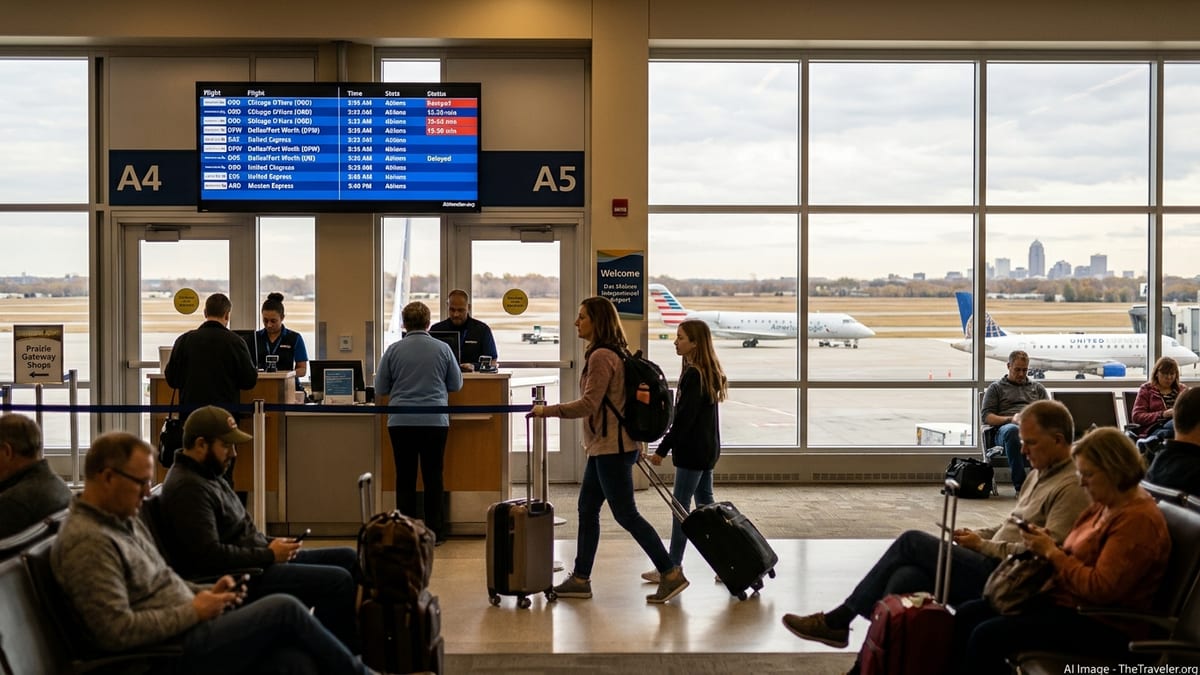
Des Moines sees manageable delays while national system strains
As the Thanksgiving peak runs from Tuesday, November 24 through Monday, November 30, Des Moines International Airport has so far avoided the severe disruption seen at some larger hubs. Federal Aviation Administration data for the North Central region on Wednesday, November 25 indicate general arrival and departure delays of 15 minutes or less at Des Moines, with no airport-wide ground stops or closures in effect.
Independent tracking sites that aggregate recent performance show that in the 10 days to November 24, departures from Des Moines averaged a delay of around 20 to 25 minutes, with a small single-digit percentage of flights canceled. That indicates some knock-on effects from problems elsewhere in the system, but not the large-scale cancellations that affected major coastal and hub airports earlier in the month.
Airport officials in Iowa have said they expect passenger volumes for the 2026 Thanksgiving period to be slightly lower than last year, which may also be helping to keep security queues and gate operations manageable. For arriving travelers, that has meant that even delayed flights are generally still making it into Des Moines on the scheduled travel day, preserving key family gatherings and holiday plans.
Recent national disruptions ripple into Chicago and Dallas connections
The relatively smooth picture in Des Moines contrasts with a series of national disruptions earlier in November. On November 13, the FAA imposed a rare nationwide ground stop after a communications failure centered in the Chicago area affected multiple control centers. The order triggered cascading cancellations and delays over several days, with more than ten thousand flights across the United States disrupted as airlines worked through the backlog.
In the days that followed, Chicago O’Hare experienced an additional brief ground stop on November 23 linked to staffing issues at air traffic control. Although normal operations resumed later that day, the pause and subsequent ground delay program added further strain during the run-up to Thanksgiving, particularly for carriers that rely on Chicago for Midwest connections, including flights to Iowa.
Dallas–Fort Worth has also faced pressure as one of the country’s busiest hubs for Thanksgiving travel. Forecasts for the week indicated that more than 120,000 passengers a day would pass through DFW on peak days, and airlines warned customers to monitor their flight status closely because of the potential for weather or system-related delays. Given that Des Moines is connected to both Chicago and Dallas by multiple daily flights, disruption at either hub has the potential to push back arrivals into Iowa, even when local conditions remain stable.
Weather, outages and airline issues combine to test Thanksgiving schedules
This year’s Thanksgiving travel period comes amid a combination of challenges for the aviation system. Long-range forecasts issued earlier in the week highlighted stormy weather and coastal flooding risks in parts of the country, especially along the coasts, increasing the likelihood of delays at major gateway airports. At the same time, a series of technology outages at individual airlines in November, including issues affecting key operational systems, led to hundreds of delayed flights nationally even before the holiday rush began.
Transportation Department data for previous holiday seasons show that November and December typically carry some of the highest delay rates of the year, and the most recent Air Travel Consumer Report indicates that Des Moines saw on-time arrival performance around the mid‑60 percent range during December 2025. More recent monthly figures for 2026 show some improvement, but they also confirm that small and mid-sized airports like Des Moines remain vulnerable to schedule shocks originating elsewhere in the network.
At Des Moines specifically, federal statistics attribute a large share of delay minutes to airline-related causes rather than local weather or air traffic restrictions. That aligns with what many Thanksgiving travelers are experiencing this week: flights that depart Chicago or Dallas later than planned because aircraft and crews are out of position, but which still operate safely and arrive in Iowa with moderate rather than extreme delays.
Local experience: busy gates, emotional reunions and practical advice
On the ground in Des Moines this week, arrival halls have been steadily busy rather than overwhelmed, with families gathering at the public exits to meet incoming passengers. Some flights from major hubs have arrived later than scheduled, but current reporting from aviation data services indicates that most inbound services are operating, and that overall delay levels at Des Moines on the day before Thanksgiving remain within what the FAA classifies as normal.
For individual passengers, even modest delays have practical consequences. Tight connections through Chicago or Dallas are particularly exposed when upstream flights leave late, and travelers who built minimal buffer time into itineraries have been among those most likely to miss onward legs. Airlines have responded by urging passengers to check their flight status using carrier apps and websites before leaving for the airport and to allow extra time in the terminal in case of longer-than-expected security lines or boarding changes.
The emotional stakes for many Thanksgiving arrivals remain high, especially for travelers who have been away from home for extended periods. Among this week’s inbound passengers are service members returning from deployments and students coming back from out-of-state universities. For them, even a short delay can feel significant, but the key point for Des Moines so far this week is that flights are largely arriving and families are reuniting, despite the wider strains on the national aviation system.
What travelers flying into or out of Des Moines should verify next
For those still traveling into or out of Des Moines over the rest of the Thanksgiving period, the main risk factors remain outside the state: weather systems moving across other regions, residual effects from earlier nationwide and hub-specific ground stops, and any further airline technology or staffing problems. None of these can be ruled out, but as of Wednesday evening there are no broad FAA restrictions or local operational issues affecting Des Moines itself.
Passengers scheduled to connect through large hubs such as Chicago O’Hare, Dallas–Fort Worth, Atlanta or Denver should regularly review their booking details in the 24 hours before departure, paying particular attention to gate changes, revised departure times and any automatic rebooking messages from airlines. Where feasible, building additional time into connections and avoiding the very last flight of the day on a given route can reduce the risk of being stranded if delays accumulate.
The airport and airlines continue to recommend that anyone meeting arriving passengers in Des Moines checks the latest arrival information before leaving for the terminal, especially through Wednesday night and into the weekend when national volumes remain high. Travelers who have flexibility may find smoother experiences on Thanksgiving Day itself or on less busy days following the holiday, but those with fixed plans can take some reassurance from the fact that, despite the broader challenges affecting U.S. aviation this month, Des Moines International Airport is currently moving Thanksgiving travelers with only moderate disruption.